 Brenda
 We are starving at the table.
The first time Chad bit into a Greek tomato, his face changed. I watched it happen across the kitchen table. This man who had spent his whole life avoiding tomatoes, picking them off burgers and pushing them to the side of his plate, suddenly holding one like he had never seen food before. He was tasting sunlight for the first time. He looked at me with a kind of wonder and asked, “Is this what a tomato is supposed to taste like?”
We had been in Greece only a few weeks. I had bought the tomatoes from the village market. They were so fresh, it was clear they’d just been picked, as most vegetables are at the market. They were misshapen, some of them split along the top from ripening too fully on the vine, deep red all the way through with that heavy, warm smell that only comes from fruit grown under the Mediterranean sun. I sliced one up with a little salt and olive oil with lunch. That was the moment my tomato-hating husband became a tomato lover. He eats them nearly every day now and talks about them the way other men talk about good wine.
I had lived in both Italy and Greece, so it was no longer a revelation to me. Chad’s whole life he had been eating something that called itself a tomato but wasn’t really one. What he grew up on in Canada was a product, grown in a greenhouse under artificial light, picked green, shipped across a continent, gassed to turn red, and placed on a supermarket shelf. It looked like a tomato. It had the shape and the color. But the energy inside it was nearly gone.
What You’re Really Eating
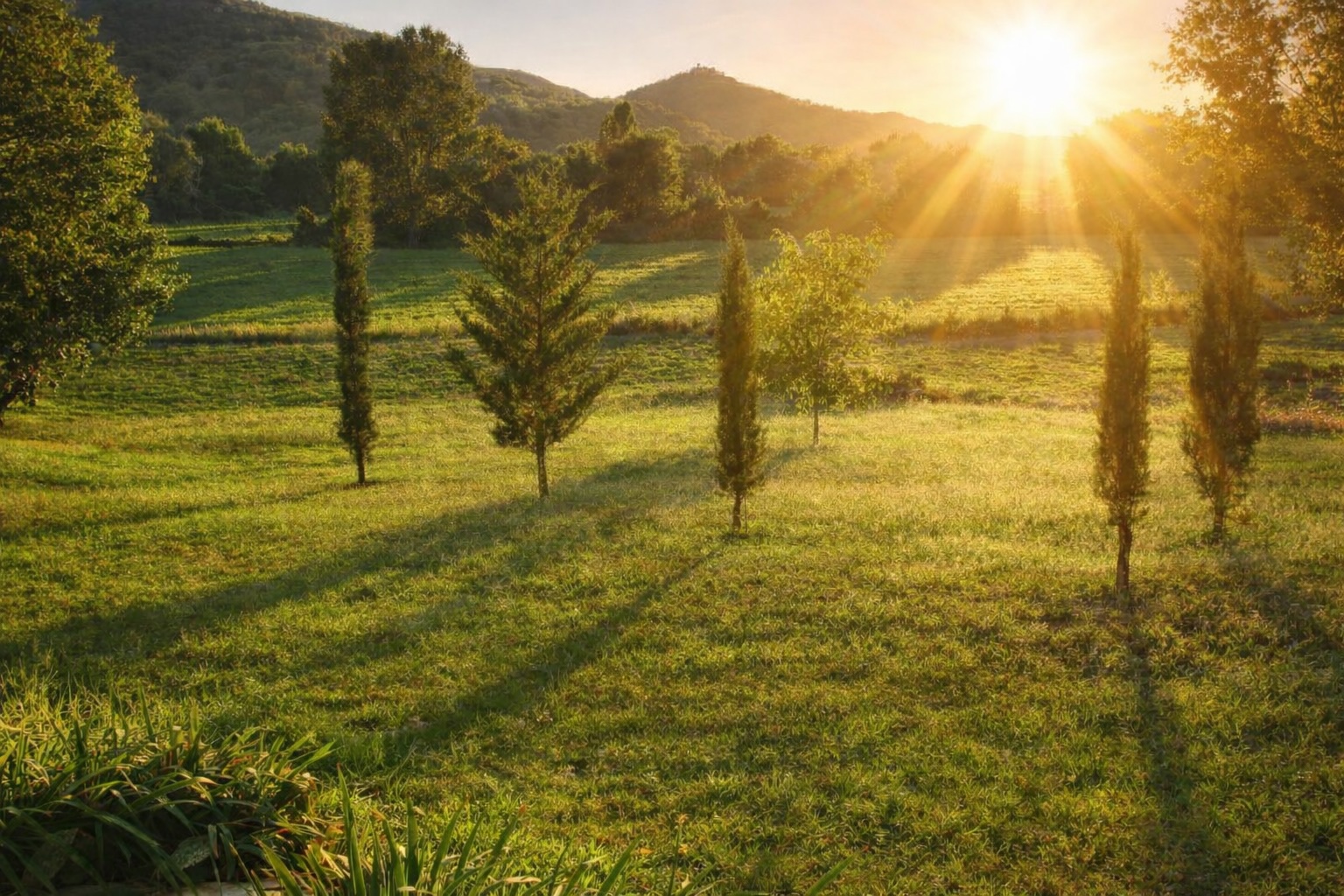
Here is something we don’t think about often enough. Every bite of food you put in your mouth is sunlight. Plants take light from the sun and, through photosynthesis, turn it into the sugars, starches, proteins, and fats that make up their bodies. When you eat a tomato, a carrot, a handful of greens, you are eating stored sunlight. When you eat a chicken or a fish, you are eating an animal that ate plants (or other animals that ate plants) that stored sunlight. It all comes back to the sun.
So the question becomes, how much sunlight is actually in your food?
A tomato grown under the Greek sky, in soil that has been there for thousands of years, ripened slowly on the vine, picked at its peak and eaten the same day, is packed with concentrated solar energy. You can taste it. Your body recognizes it. There is a reason Chad’s face lit up. His cells were getting something they had been missing his whole life.
A tomato grown in a climate-controlled greenhouse under LED lights, fed on liquid fertilizer in a sterile medium, picked while still green and artificially ripened in a warehouse, has almost none of that. It has a little bit of water, a little bit of sugar, and some cellulose to hold its shape. The sunlight is barely there. Your body eats it and gets very little energy in return.
This is why people can eat and eat and still feel hungry. They are consuming volume, but not the expected energy. The body keeps asking for more because it’s still waiting for what it needs.
The Further It Travels, the Less It Holds
Sunlight in food begins to fade the moment the plant is harvested. A lettuce leaf picked this morning from your garden is a different creature than one that has been sitting in a plastic bag in a refrigerated truck for ten days. The substance is still there, but the living energy has drained out. Studies on nutrient loss in vegetables are sobering. Vitamin C in spinach can drop by half in a week of storage. Fresh herbs lose their volatile oils, the very things that make them medicinal, within hours of being cut.
Now think about processed food. By the time wheat has been stripped of its bran and germ, bleached, combined with seed oils, sugar, preservatives, artificial flavors, and packaged into something shelf-stable for two years, the original sunlight is long gone. What you’re eating is a chemical approximation of food. Your body doesn’t know what to do with it. There’s no energy to absorb, only calories to store.
And this is where I think a lot of our modern health problems come from. We are eating more food than any generation in history and we are more tired, more sick, more depressed, more anxious than ever. The volume is there, but the life is missing. We are starving at the table.
Eating Like Your Great-Grandmother
The women of the Mani peninsula still go out with their bags and small knives to gather horta from the hillsides. They pick wild chicory, dandelion greens, wild amaranth, purslane, nettle, mustard greens, whatever is in season and growing where it has always grown. They bring it home, boil it for a few minutes, dress it with olive oil and lemon and a little salt, and they eat it. Often they drink the cooking water too for the minerals.

This is food that is so full of sunlight it almost glows. These plants have not been coddled. They’ve grown under intense Mediterranean light, fought for their place in rocky soil, pushed their roots deep for water and minerals. All of that life goes into your body when you eat them. The Greek women know this intuitively. They have been eating this way for thousands of years, and it has kept their families alive through wars and famines and hard times.
The same is true of food grown in your own garden, no matter where you live. A handful of herbs pinched from your kitchen windowsill is more powerful than a whole bottle of the same herb purchased in a supermarket jar. A carrot pulled from your own soil has more of the sun in it than one trucked in from halfway across the world. Your body knows the difference, even if your mind has been trained to ignore it.
What to Do About It
Start paying attention to where your food comes from. Not in a stressful, obsessive way, but with curiosity. Ask yourself, how much sunlight energy is in this? How long ago was it alive? How far has it traveled to reach me?
Then, wherever you can, choose the food with more life in it.
Buy local. Go to the farmer’s market and talk to the people who grew your food. Ask them when it was picked. If they can tell you it was pulled from the soil yesterday or this morning, you are getting something with real energy in it. Pay a little more if you have to. You will eat less because your body will be satisfied, and the savings often work themselves out.
Eat in season. Tomatoes in January were not meant to exist. Strawberries at Christmas are a trick of the supply chain, not a gift from the earth. When you eat what the land around you is producing right now, you are eating food at its peak of solar energy. Your body also needs different things in different seasons. In summer you need the cooling, watery foods like cucumbers and melons. During winter, you need the warming roots and stored grains and preserved things our great-grandmothers put up in the fall. The seasons have their own wisdom.
Grow your own, even a little. You don’t need a farm. A few pots of herbs on a balcony, a small bed of greens outside your kitchen door, or a single tomato plant in a sunny corner. The food you grow yourself carries an energy nothing else can match, partly because it has been cared for by your own hands and partly because you eat it the day you pick it. There is nothing in the supermarket that can compete with that.

And if you can’t grow your own and you can’t always buy local, that’s okay too. Do what you can. Add a little more sunlight to your plate each week. Your body will start to notice. You’ll find yourself craving the living things and losing interest in the dead ones.
We are made of sunlight, in the end. Every cell in your body was once a plant that was once a beam of light from the sun. When you eat food that has kept that light intact, you are feeding the oldest part of yourself. When you eat food that has lost it, you are running on empty.